
- Posts: 5
- Thank you received: 1
 1st timer, is 28% Sodium Chlorite MMS?
- jaubin
-
 Topic Author
- Offline
- New Member
-

Less
More
30 Jul 2015 20:12 #49973
by jaubin
1st timer, is 28% Sodium Chlorite MMS? was created by jaubin
I know this is a stupid question, but I want to be sure I'm doing this correctly.
I purchased 28% Sodium Chlorite and 50% Citric acid from the supplier. I assume the 28% Sodium Chlorite is the MMS, and that I should mix 3 drops of the 28% with 3 drops of the 50% to make a solution for the Protocol 1000?
In my case I've got skin cancer, so I'm mixing 20 drops of the 28% and 100 drops of the 50% into a 2 oz bottle for spraying.
If I'm wrong in my assumptions please advise, someone. I've also got a friend with throat cancer (he's been fighting this for 2 years) who is in need of this help and he, more than me, needs to make sure this is all correct.
Thank you,
Jay
I purchased 28% Sodium Chlorite and 50% Citric acid from the supplier. I assume the 28% Sodium Chlorite is the MMS, and that I should mix 3 drops of the 28% with 3 drops of the 50% to make a solution for the Protocol 1000?
In my case I've got skin cancer, so I'm mixing 20 drops of the 28% and 100 drops of the 50% into a 2 oz bottle for spraying.
If I'm wrong in my assumptions please advise, someone. I've also got a friend with throat cancer (he's been fighting this for 2 years) who is in need of this help and he, more than me, needs to make sure this is all correct.
Thank you,
Jay
Please Log in or Create an account to join the conversation.
- CLO2
-

- Offline
- Administrator
-

30 Jul 2015 20:50 #49975
by CLO2
Replied by CLO2 on topic 1st timer, is 28% Sodium Chlorite MMS?
Hello jaubin. There are no stupid questions.
Your recipe for a spray bottle is not correct. You have found old info which used 10% citric acid.
Please DO NOT start with a 3 drop dose! I highly advise spending 20 bucks and get Jim's latest book in pre-release ebook form here . When the final version is published, they will send you a free copy. That book will answer all your questions.
When you're tired of the horrible taste, buy a bottle of 4% HCL.
Yes, that is MMS. When you mix MMS with 50% citric acid or 4% HCL, you now have MMS1.I assume the 28% Sodium Chlorite is the MMS
Your recipe for a spray bottle is not correct. You have found old info which used 10% citric acid.
Please DO NOT start with a 3 drop dose! I highly advise spending 20 bucks and get Jim's latest book in pre-release ebook form here . When the final version is published, they will send you a free copy. That book will answer all your questions.
When you're tired of the horrible taste, buy a bottle of 4% HCL.
The following user(s) said Thank You: fourfingerz
Please Log in or Create an account to join the conversation.
- jaubin
-
Topic Author
- Offline
- New Member
-
Less
More
- Posts: 5
- Thank you received: 1
31 Jul 2015 00:51 #49977
by jaubin

I'm sorry, but I am now more confused than previously.
I purchased Jim's e-book. I don't have time to read through the entire book at this time, and my search for 'skin cancer' helps me not much.
I see reference to 'activated drop.' An 'activated drop' is what... 1 to 1 of 28% sodium chlorite to 50% of citric acid?
How many drops of each do I put into a 2 oz spray bottle, swirl to activate, then add water?
I do understand that this is self-medication, and that I can adjust my dosage, but where's my starting point?
Lost
Replied by jaubin on topic 1st timer, is 28% Sodium Chlorite MMS?
I'm sorry, but I am now more confused than previously.
I purchased Jim's e-book. I don't have time to read through the entire book at this time, and my search for 'skin cancer' helps me not much.
I see reference to 'activated drop.' An 'activated drop' is what... 1 to 1 of 28% sodium chlorite to 50% of citric acid?
How many drops of each do I put into a 2 oz spray bottle, swirl to activate, then add water?
I do understand that this is self-medication, and that I can adjust my dosage, but where's my starting point?
Lost
Please Log in or Create an account to join the conversation.
- CLO2
-
- Offline
- Administrator
-
31 Jul 2015 05:18 #49979
by CLO2
Replied by CLO2 on topic 1st timer, is 28% Sodium Chlorite MMS?
Jay, if you have never ingested MMS before then start here:
Protocol Starting Procedure
Also on page 40 of the book.
You use MMS and an activator, which in your case is 50% citric acid. One drop of MMS plus one drop of activator activated for 30 seconds is a 1 drop dose of MMS1 when added to about 4 fl oz of water. That is for ingestion.
At the bottom of this page is Protocol 3000 which is a spray protocol. The book has an updated version on page 55. There is also a MMS patch protocol for skin use and it is on page 60.
This info should get you started.
You use MMS and an activator, which in your case is 50% citric acid. One drop of MMS plus one drop of activator activated for 30 seconds is a 1 drop dose of MMS1 when added to about 4 fl oz of water. That is for ingestion.
At the bottom of this page is Protocol 3000 which is a spray protocol. The book has an updated version on page 55. There is also a MMS patch protocol for skin use and it is on page 60.
This info should get you started.
The following user(s) said Thank You: fourfingerz, jaubin
Please Log in or Create an account to join the conversation.
- jaubin
-
Topic Author
- Offline
- New Member
-
Less
More
- Posts: 5
- Thank you received: 1
02 Aug 2015 21:09 #49996
by jaubin
Replied by jaubin on topic 1st timer, is 28% Sodium Chlorite MMS?
Thank you for your help on all of this. I have Jim's (pre-release) book and have gained quite a bit of knowledge.
I do have another question though. I am in day 4 of the spray protocol for the cancer spot on my back (10 drops activated MMS / 1 oz bottled water in a spray bottle, once every hour). I'm also into my 3rd day of the internal starter procedure, up to 1/2 drop/hr. now. I don't feel any discomfort (maybe because I broke my neck years ago and never regained full feeling and functionality in many parts of my body) but it's bothering my wife. She says it looks like the affected area is growing in size and, when I wear a shirt, I'm bleeding on my shirt.
Is this to be expected?
I do have another question though. I am in day 4 of the spray protocol for the cancer spot on my back (10 drops activated MMS / 1 oz bottled water in a spray bottle, once every hour). I'm also into my 3rd day of the internal starter procedure, up to 1/2 drop/hr. now. I don't feel any discomfort (maybe because I broke my neck years ago and never regained full feeling and functionality in many parts of my body) but it's bothering my wife. She says it looks like the affected area is growing in size and, when I wear a shirt, I'm bleeding on my shirt.
Is this to be expected?
Please Log in or Create an account to join the conversation.
- CLO2
-
- Offline
- Administrator
-
02 Aug 2015 22:16 #49997
by CLO2
Replied by CLO2 on topic 1st timer, is 28% Sodium Chlorite MMS?
Jay, bleeding from the cancer spot is possible. I had a cancer spot on my back last year and used black salve or Indian herb on it and after 29 days it fell off.
Since it is bleeding, if you had some CDS, which is only chlorine dioxide in water, I would apply that to the bleeding area often. You can use what you have (MMS1), but I think CDS would be more appropriate in my experience. I would apply CDS full strength.
With the MMS and 50% citric acid you already have, you can make CDS overnight. Take a look at this PDF file and see if you want to try to make it. You don't need the exact same containers. The instructions are on page 5, part 6.
Since it is bleeding, if you had some CDS, which is only chlorine dioxide in water, I would apply that to the bleeding area often. You can use what you have (MMS1), but I think CDS would be more appropriate in my experience. I would apply CDS full strength.
With the MMS and 50% citric acid you already have, you can make CDS overnight. Take a look at this PDF file and see if you want to try to make it. You don't need the exact same containers. The instructions are on page 5, part 6.
Please Log in or Create an account to join the conversation.
- jaubin
-
Topic Author
- Offline
- New Member
-
Less
More
- Posts: 5
- Thank you received: 1
03 Aug 2015 15:41 #50005
by jaubin
Replied by jaubin on topic 1st timer, is 28% Sodium Chlorite MMS?
I am about to "cook" my CDS as instructed above, but using 1/2 the amounts recommended. You are suggesting that I "apply CDS full strength" which I am taking to mean that I should spray this onto my affected area rather that ingest, so I will place 6 drops each of 28% sodium chlorite/50% citrus acid in a glass container, place this container in 4 oz. water, seal and let sit for 12 hours. (I have attached a picture of my "works.) Then I will take an oz. or 2 at a time and put this into my spray bottle, which lasts for about 4 days.
Does this sound acceptable?
And thank you for your quick replies.
Does this sound acceptable?
And thank you for your quick replies.
The following user(s) said Thank You: CLO2
Please Log in or Create an account to join the conversation.
- CLO2
-
- Offline
- Administrator
-
04 Aug 2015 00:04 - 04 Aug 2015 00:43 #50006
by CLO2
Replied by CLO2 on topic 1st timer, is 28% Sodium Chlorite MMS?
Jay, your setup looks good, but I would use a larger reactor (the smaller container that will hold the MMS and 50% citric acid) that will hold at least 60ml of solution. We don't want any reactor solution spilling into the distilled water.
The recipe is:
In the large glass container (the receiver) put 240ml (8 fl oz) of distilled water. When done cooking this will be 240ml of about 3000ppm CDS.
In the smaller glass container (the reactor) put 12ml of MMS plus 12ml of 50% citric acid. A US tablespoon holds about 15ml so use an almost full tablespoon of each.
When you add the second solution, a reaction will happen quickly, so it is best to put one solution in the reactor container outside the receiver and then put the reactor with the one solution inside the receiver which now has 240ml of water. Now, add the other solution to the reactor and gently stir with something plastic and quickly cap the receiver so no CLO2 gas escapes. Some of the CLO2 gas from the reactor will go into the distilled water which then is called CDS.
Be careful not to let any of the reactor solution spill into the distilled water in the receiver. Put the setup in a dark cabinet at room temp for about 12 hours. After that, carefully take it out of the cabinet and put in a fridge for at least one hour to cool down the CDS so when you finally open the receiver to take out and dispose of the reactor solution, little CLO2 gas will escape.
Yes, you can cut this recipe in half. Keep the CDS in the spray bottle in a fridge when not using it. You can spray the CDS full strength onto the spot or use a saturated Q-tip to apply it. Or, you could use the Patch Protocol (page 60) substituting CDS for MMS1, 2 parts CDS to 1 part water and 1 part DMSO. 20 drops of full strength CDS plus 10 drops of water plus 10 drops of DMSO. Continue at Step 2 of the Patch Protocol. Be sure you have read the DMSO Allergy Warning on page 48.
You should also continue ingesting MMS1 as per The Starting Procedure, then onto Protocol 1000, etc.
Hope this is clear.
The recipe is:
In the large glass container (the receiver) put 240ml (8 fl oz) of distilled water. When done cooking this will be 240ml of about 3000ppm CDS.
In the smaller glass container (the reactor) put 12ml of MMS plus 12ml of 50% citric acid. A US tablespoon holds about 15ml so use an almost full tablespoon of each.
When you add the second solution, a reaction will happen quickly, so it is best to put one solution in the reactor container outside the receiver and then put the reactor with the one solution inside the receiver which now has 240ml of water. Now, add the other solution to the reactor and gently stir with something plastic and quickly cap the receiver so no CLO2 gas escapes. Some of the CLO2 gas from the reactor will go into the distilled water which then is called CDS.
Be careful not to let any of the reactor solution spill into the distilled water in the receiver. Put the setup in a dark cabinet at room temp for about 12 hours. After that, carefully take it out of the cabinet and put in a fridge for at least one hour to cool down the CDS so when you finally open the receiver to take out and dispose of the reactor solution, little CLO2 gas will escape.
Yes, you can cut this recipe in half. Keep the CDS in the spray bottle in a fridge when not using it. You can spray the CDS full strength onto the spot or use a saturated Q-tip to apply it. Or, you could use the Patch Protocol (page 60) substituting CDS for MMS1, 2 parts CDS to 1 part water and 1 part DMSO. 20 drops of full strength CDS plus 10 drops of water plus 10 drops of DMSO. Continue at Step 2 of the Patch Protocol. Be sure you have read the DMSO Allergy Warning on page 48.
You should also continue ingesting MMS1 as per The Starting Procedure, then onto Protocol 1000, etc.
Hope this is clear.
Last edit: 04 Aug 2015 00:43 by CLO2.
Please Log in or Create an account to join the conversation.
Time to create page: 0.933 seconds
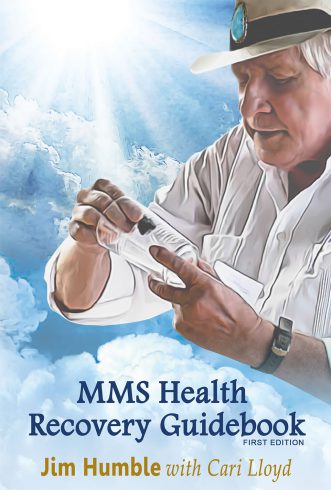
The MMS HEALTH RECOVERY GUIDEBOOK is Jim’s latest book. It provides the latest information on how to safely use MMS. Click the book image to order your copy today.
Jim's Blog
-
Unpleasant Symptoms, Biofilms, Going Too Fast
Published on: October 14, 2026
Note: In a health context, a biofilm is a structured, highly organized community of microorganisms (such as bacteria or fungi) that adheres to a surface and is encased within a self-produced, sticky, gel-like matrix of proteins, DNA, and sugars. Instead of floating freely as individual cells, the microbes (bad stuff) physically cluster together to form …
-
Cravings/Weight Management/Blocked Veins
Published on: October 4, 2026
A conversation with Jim in 2010: D: Some doctors have told me that harmful pathogens have the ability to manipulate the brain chemistry to make you crave the things they want to eat. Since I have been on MMS/CD, I have lost all cravings. I have also lost 60 pounds (which I needed to lose), …
-
Flu Season
Published on: September 28, 2026
The flu is a lot more dangerous sometimes than people realize and flu can make you very, very sick. There are some flu’s today that are highly resistant to most everything. So with flu and colds that just won’t go away and with pneumonia, here is another suggested approach you can try if the standard …
-
Making Health Decisions
Published on: September 22, 2026
Following is Jim’s answer to someone who was struggling with trying to get a loved one to follow certain procedures regarding their health: Jim: It is important to understand, that what a person decides to do about their own health is a very personal matter. In addition, there are so many factors involved in making …
-
MMS/CD and Antioxidants
Published on: September 14, 2026
Some folks get confused and a bit hung up on the issue of MMS/CD and antioxidants. While it is true, we have said and many others emphasize, you cannot take MMS/CD with antioxidants. Fair enough, it stands to reason that taking antioxidants with an oxidizer is not the best thing to do. BUT, you have …
-
Why it’s Not Working
Published on: September 2, 2026
From a discussion with Jim on why MMS/CD doesn’t seem to be working: Jim: If it’s not working, do something different. But this can be tricky, you have to give each thing enough time to work, don’t be rash, but don’t stay stuck either, this is where listening to your body comes in and the …